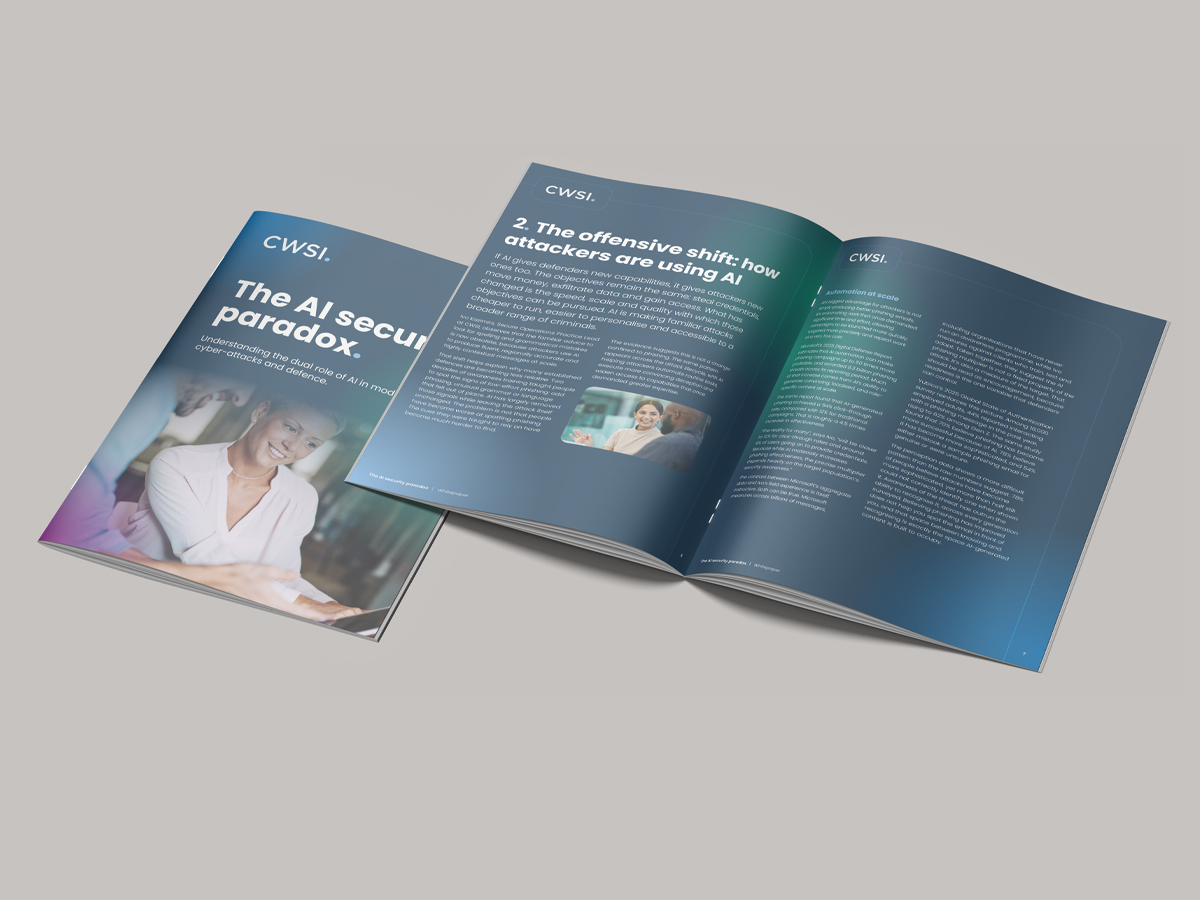
AI is quickly becoming part of everyday business. It is changing how organisations work, how decisions are made and how routine tasks are completed. Cyber security is no exception.
The difference is that AI is not only changing the way organisations defend themselves. It is also changing the way attacks are planned, created and carried out. The same technology is strengthening both sides.
This blog looks at how AI is reshaping the threat landscape, where it can strengthen security operations, and why the advantage will come from applying it in the right way rather than simply adopting it.
How AI is changing the threat landscape
One of the clearest effects of AI is the way it is changing how attacks are planned and delivered. Three developments are becoming increasingly apparent:
Faster attacks at greater scale
Attackers can automate reconnaissance, shorten exploitation cycles and target more organisations at once.
More convincing attacks
AI can produce fluent, relevant phishing messages and support social engineering that adapts to different audiences.
A lower barrier to entry
People with limited technical expertise can now access capabilities that previously required more skill and time.
The impact is perhaps most visible in phishing. For years, people were taught to look for poor grammar, unusual phrasing or messages that felt out of place. AI has made those signs far less reliable. People have not become worse at spotting phishing. The warning signs they were taught to recognise are becoming harder to see.
How AI can strengthen defense
The same qualities that make AI useful to attackers can also help defenders.
AI can process large volumes of data, identify patterns and highlight unusual activity more quickly than a person working alone. It can also take on repetitive triage work, giving security teams more time to focus on investigation and decision-making.
But AI does not replace human judgement. It reinforces it. By reducing routine work and bringing the most relevant activity to the surface, AI helps teams respond more consistently, even when alert volumes are high and resources are stretched.
The real risk is falling behind
AI is changing both sides of cyber security. Attackers are using it to work faster and make familiar techniques more effective. Security teams can use it to reduce noise, strengthen detection and respond with greater confidence.
The question is no longer whether AI has a role in cyber security, but how organisations can apply it in ways that genuinely improve their security operations. Around three-quarters of organisations now use AI somewhere in cyber security, yet only around a third use it extensively. The difference is not access to the technology. It is how effectively it is applied.
As CWSI’s Secure Operations Practice Lead, Ivo Kazimirs, puts it: “Attackers will use AI whether organisations choose to adopt it or not. Ignoring it does not remove the risk. It makes it harder to keep pace.”
What this means for security leaders
Using AI effectively is about more than introducing another technology. It means deciding where it adds value, how it fits into existing security operations and where human judgement remains essential.
The strongest security operations are unlikely to be those with the most AI. They will be the ones that combine AI with the right people and processes, using it to reduce routine work, surface the activity that matters and support better decisions.
As CWSI’s Secure Operations Practice Lead, Ivo Kazimirs, puts it: “AI is a tool. Powerful, but one that still needs management, validation and oversight.”