Security stacks rarely become complex by design. They grow over time. As new risks emerge, new tools are added to address them. Each decision makes sense in isolation.
The challenge comes later, as the number of platforms grows, so does the effort needed to connect them, manage them and make sense of the information they produce.
More tools do not automatically lead to better security. Effective security depends not only on the technology in place, but on how well the operation behind it works.
This blog explores why adding more technology does not always lead to better security, where tool-driven security starts to create new challenges and what organisation can do the build a more effective security operation.
The comfort of feeling in control
More tools can create a strong sense of control. Coverage looks broad. Dashboards are full. Alerts are flowing. On the surface, everything appears to be covered. But activity is not the same as effectiveness.
It is easy to look at everything the stack is doing and assume it adds up to better protection. Sometimes it does. Sometimes it creates more noise and more places for important information to get lost.
Why more can mean worse
The impact is rarely immediate. It shows up in day-to-day operations, where small inefficiencies accumulate over time. In practice, that often leads to four common challenges:
Fragmentation instead of visibility
Tools operate in separate systems. Data is not shared or correlated, leaving teams with several partial views of a threat rather than one complete picture.
Complexity instead of clarity
Every platform needs to be managed, tuned and maintained. More tools create more overhead and make it harder to identify what matters.
Manual effort instead of automation
When tools don’t share context effectively, teams spend more time switching between platforms, piecing together information and coordinating responses.
Slower response instead of faster decisions
As complexity grows, investigations take longer, priorities become harder to judge and responding confidently becomes more difficult.
The scale of the challenge is reflected in the numbers. The average organisation now manages around eleven separate security consoles, while close to half of the alerts they produce are false positives.
That is not simply a lack of coverage. It is a coordination problem.
What tools cannot provide
The missing ingredient is rarely another product. More often, it is the right combination of people and processes.
Even strong technology will underperform without people who can interpret what it shows, prioritise the right issues and act with confidence.
It also needs clear processes. Teams need defined workflows for detection and response, clear ownership, and a consistent way to manage incidents from beginning to end.
Technology provides the capability. Process gives it structure. People apply judgement and take action.
Security improves when all three work together.
The temptation to add AI
That balance becomes even more important as new technologies enter security operations. AI, for example, has the potential to strengthen security, but only when it supports the people and processes already in place, rather than adding another layer of complexity.
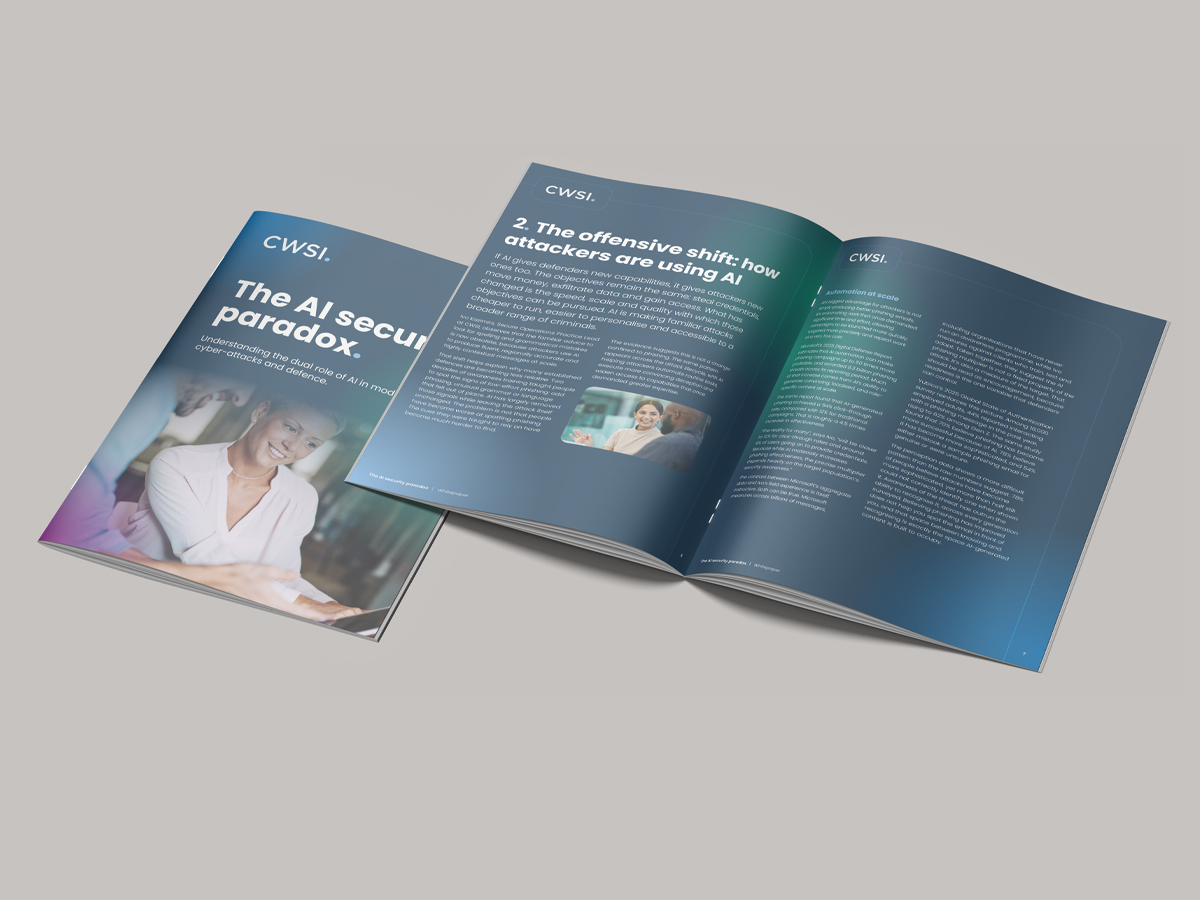
As CWSI’s Secure Operations Practice Lead, Ivo Kazimirs, explains in our latest whitepaper, AI delivers the greatest value when it’s treated as a capability to be managed, rather than a replacement for human judgement: “AI is a tool. Powerful, but one that still needs management, validation and oversight.”
The organisations getting value from AI are not necessarily the ones using the most of it. They are the ones applying it within a well-run security operation, where it removes routine noise and leaves people to focus on the decisions that require experience and judgement.