Most organisations began their AI journey with tools. Sensible enough, the tools are familiar. They sit inside email, documents, meetings and collaboration platforms. They help people summarise, draft, search and analyse.
But AI is now moving into a different phase. The conversation is shifting from AI that assists people to AI that acts across systems and that distinction matters.
AI assistants, such as Microsoft 365 Copilot, are designed to support individuals in the flow of work. AI agents go further. They can coordinate tasks, connect systems, trigger workflows and act on behalf of users within defined boundaries.
In this blog we explain how organisations are moving from early use of ready-made tools towards more connected AI capabilities that are built into how work actually gets done. We look at how AI success is not defined by the tools an organisation adopts, it’s defined by how deliberately those tools are used across the business.
The shift from assistants to agents
AI assistants have already proved useful. They can summarise meetings, generate documents, search across approved content and help people make sense of information faster. Used well, they reduce friction in everyday work.
AI agents change the shape of the conversation because they are not limited to helping one person complete one task. They can support processes that move across teams, platforms and business functions.
Agents can execute repetitive workflows, route requests across systems, prepare reports before meetings, trigger actions in CRM, ERP and operational platforms, coordinating processes across departments.
The distinction matters because assistants and agents carry different levels of responsibility. Assistants help people work faster, while agents can take action across systems, so organisations need to be much clearer about access, oversight and accountability before giving them room to move. Assistants support people. Agents act across systems.
Microsoft believes that organisations will need both assistants and agents: “Agents handle complex, multistep work across systems. Assistants help individuals work smarter and faster.”
Where agents can change operations
The value of AI agents becomes clearer when you look at the everyday operational work that keeps organisations moving. Much of it is essential. Much of it is repetitive. Quite a bit of it depends on someone remembering to update the right system, chase the right person or pull together the right report. A noble tradition, but not always an efficient one.
IT and service operations
Agents can help triage and route support tickets, resolve common service issues and escalate incidents based on context. Instead of every request starting from zero, the agent can gather information, apply rules and move the issue to the right place.
Finance and budget management
Agents can consolidate data across systems, flag anomalies, prepare budget summaries and trigger approval workflows. That does not remove judgement from the process. It gives people better information earlier, and fewer spreadsheets held together by hope.
Sales and marketing
Agents can update CRM records, prepare account briefings, coordinate campaign workflows and route qualified leads. The benefit is not just speed. It is consistency. Teams spend less time piecing together information and more time using it.
Project and operations management
Agents can track milestones, coordinate cross-team dependencies, flag delivery risk and prepare operational reporting. For organisations managing multiple regions, systems or business units, that kind of coordination can make a real difference.
Across these examples, the pattern is the same. Agents reduce manual coordination so employees can focus on higher-value work: judgement, problem-solving, client conversations and decisions that need context.
Building agents on a secure foundation
When AI moves from suggesting to acting, security becomes operationally critical.
Agents need access to systems and data to be useful. But that access must be controlled. Organisations need to ensure agents only use information they are authorised to access. Role-based controls must be clearly defined. Sensitive data must be classified and protected. Activity must be logged and monitored. Policies must govern where agents can act autonomously and where human approval is required.
This is where governance earns its keep.


That’s especially true for agents because their value depends on connection. They become more useful when grounded in enterprise data and linked to core systems such as CRM, ERP and operational platforms. But connection without control is not progress. It is just risk with a nicer interface.
This is where AI Security and Governance matters. It gives organisations the controls, guardrails and operating model needed to scale AI without leaving risk to sort itself out later.
The operating model question
As organisations experiment with AI agents, a bigger question appears: how should intelligence flow across the business?
That sounds grand, but the practical questions are simple.
- What authority should agents have?
- Which systems should they connect to?
- Where does human oversight sit?
- How is accountability defined?
- When should an agent recommend, and when should it act?
These aren’t just technology decisions, they’re operating model decisions.
The challenge is not just choosing the right tool. It’s deciding “where assistants help people work better, where agents can act across systems and workflows, and how these capabilities build on each other rather than becoming another layer of complexity.” Johnny Sheehan, CWSI
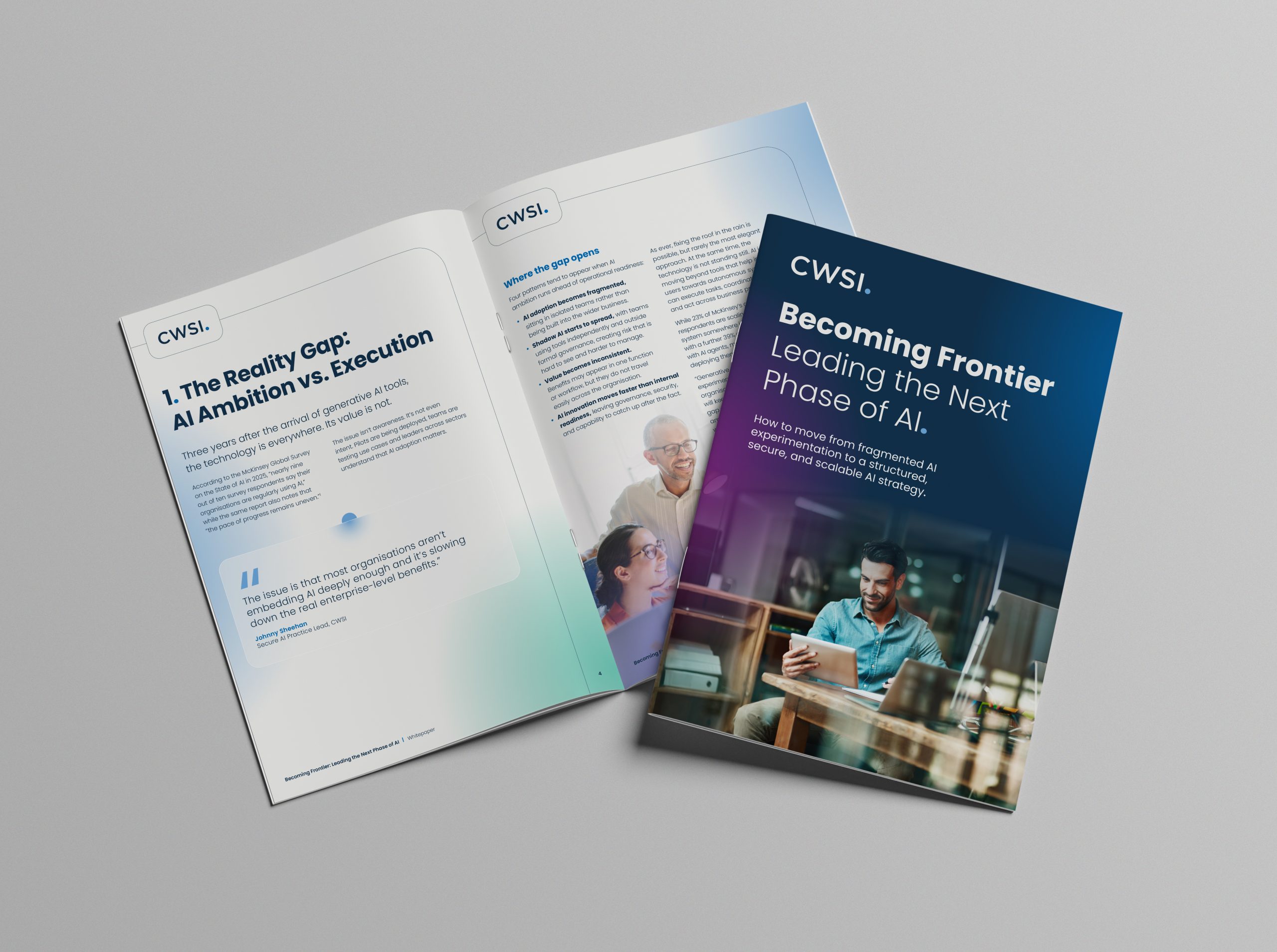
Our whitepaper Becoming Frontier: Leading the Next Phase of AI describes this journey as moving from fragmented AI experimentation towards “a structured, secure, and scalable AI strategy that delivers real business value.” That structure matters because agents can touch processes that cross departmental boundaries. If every team builds its own agent in isolation, the organisation may simply recreate old silos with newer tools. Very modern. Not especially helpful.
Forward-thinking organisations are taking a more deliberate approach. They are looking at where assistants improve individual productivity, where agents can coordinate work across systems, and how both can develop together without adding another layer of complexity.
From automation to intelligent operations
AI agents mark a shift from tools that support individual tasks to systems that can coordinate work across teams, platforms and processes.
Used well, they can help people move faster through everyday work. They can summarise information, trigger follow-up actions, support service teams, reduce manual admin and help employees find what they need without digging through five systems and three versions of the truth. Small wins, repeated often, have a big impact.
There is growing evidence that the value is real, when the foundations are in place. A Forrester Total Economic Impact study commissioned by Microsoft found that Microsoft 365 Copilot delivered a 116% ROI over three years for a composite organisation, with users saving an average of nine hours per month.
Microsoft’s 2024 Work Trend Index also found that 75% of global knowledge workers were already using generative AI, showing that adoption is moving faster than many formal governance plans. That gap matters.
But AI agents only work safely when they’re built on strong foundations: clear access controls, protected data, visible activity and proper governance. Without those, they can move risk around the business just as efficiently as they move work.
That’s where CWSI can help. As Microsoft-first security and compliance experts, we work with organisations to put the right controls in place before AI agents are widely adopted. We help make sure data is protected, permissions are clean, activity can be monitored and governance keeps pace with how people actually work.
The result is AI adoption that is more useful, more measurable and easier to trust. Teams get support with the repetitive work that slows them down. Leaders get better visibility and control. The business gets a clearer path to value without adding unnecessary risk in the background.