Mergers and acquisitions can help organisations grow quickly across Europe. They can also bring together different systems, policies and ways of working, which makes secure AI adoption harder to manage. During a merger or acquisition, leadership teams quite rightly focus on financial performance, operational integration and value creation. But governance alignment often lags behind. That matters more now because AI tools like Microsoft 365 Copilot use the data, permissions and policies already in place. They don’t wait for integration to be finished.
If those foundations are inconsistent, AI will not create the risk on its own. It will simply make the gaps easier to find. Sometimes by the wrong people.
In this blog we look at how AI ambition is moving faster than organisational readiness and how without structure and control, adoption fragments and value stays local.
Growth is accelerating, so is complexity
Cross-border growth brings more moving parts
Cross-border expansion is common across Europe. Private equity-backed organisations often pursue pan-European strategies, building groups that span multiple jurisdictions, entities and operating models. Regional growth can bring real opportunity, but it also creates technical and governance complexity.
Integration rarely happens overnight
After acquisition, technology consolidation is rarely immediate. Businesses may continue operating with separate Microsoft 365 tenants, different endpoint controls, varied data classification standards and local compliance processes. Some business units may be well governed. Others may still rely on older tools, inherited permissions or informal ways of working.
Governance gaps tend to travel with the deal
This is the governance lag problem. One business may have mature data labelling. Another may not label sensitive documents at all. One region may apply strict access controls. Another may rely on broad sharing groups created years ago and never reviewed, because everyone had other things to worry about.
In practical terms, this can mean: Separate or partially integrated Microsoft 365 tenants. Different data labelling standards. Inconsistent policies. Uneven access control maturity. Separate IT leadership structures. Legacy tooling retainedlonger than planned. Different compliance frameworks followed across regions.
None of this is unusual. It is the normal furniture of post-acquisition life. The issue is that AI changes how visible and risky that furniture becomes.
AI moves quickly when controls are unclear
AI adoption often moves faster than governance harmonisation. Teams want to experiment. Leaders want to capture value quickly. Employees want tools that help them get through the day. In the absence of clear controls, people will often find their own routes. That is where shadow AI begins to creep in.
Readiness gives leaders a clearer view
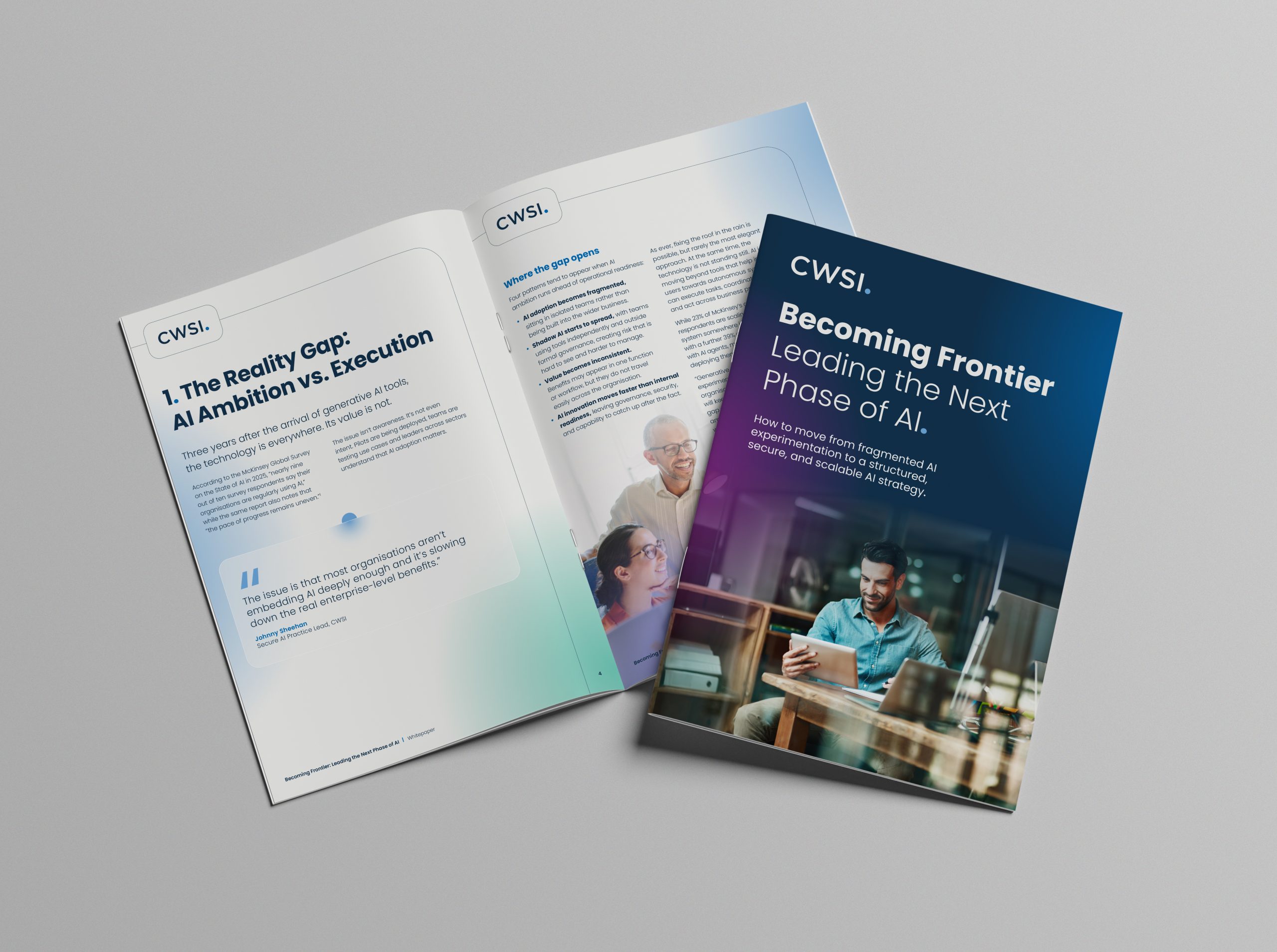
In Becoming Frontier, we talk about the spread of shadow AI, and how teams using tools independently and outside formal governance, creating risk that is hard to see and harder to manage.
This is where AI readiness becomes more than a technical checklist. It gives leadership a clearer view of where AI is already being used, where controls are thin, and what needs to be brought into line before adoption scales.
That point is especially relevant after M&A. Newly acquired teams may already be using public AI tools in daily workflows. They may have enabled Copilot locally. They may be sharing data with unsanctioned platforms because the approved route feels too slow or unclear. Usually, this is not reckless behaviour. It is people trying to get work done. Still, good intentions do not make data exposure any less awkward.
Why AI changes the risk equation
AI tools are powerful because they can surface information across large data estates, summarise content, generate outputs and support decisions at speed. But they rely heavily on the quality of the underlying controls.
If permissions are too broad, AI may surface information a user should not need. If labels are inconsistent, sensitive content may not be handled correctly. Strong data governance and protection helps organisations understand where information lives, who can access it, and how it should be protected before AI starts surfacing it at speed.
Microsoft’s Secure and Govern M365 Copilot blueprint warns that “if grounding data and Copilot interactions are not secured, it could lead to access to information beyond what the user needs for their role, unauthorized disclosure of confidential information, and out of date or irrelevant responses.”
The core point is simple: M&A does not create AI risk from nowhere. It exposes governance inconsistency that AI makes more visible.
The due diligence blind spot
Traditional IT due diligence tends to focus on security posture, compliance exposure, infrastructure maturity, tooling overlap and contractual risk. These are all important. But AI introduces a newer set of questions that many diligence processes are still catching up with.
Has AI already been deployed? Is Copilot enabled anywhere in the group? Are permissions aligned to governance standards? Is there an AI acceptable use policy? Are employees using unsanctioned AI tools in daily workflows? Can AI-related risk be evidenced clearly at board level?
For acquiring organisations, these questions matter because once the deal completes, the risk transfers. Exposure becomes consolidated. Fixing issues becomes more complex, especially when integration decisions have already been made.
AI governance does not need its own diligence empire. But it should now form part of technology risk assessment in the M&A process.
The innovation paradox after acquisition
Post-M&A organisations face a familiar tension. Leadership wants to capture value quickly, while security and IT teams know controls are not yet consistent. Without alignment, AI rollout can stall, regions move independently and governance becomes reactive.
This is where secure AI governance becomes an enabler, not a blocker. Johnny Sheehan, Secure AI Practice Lead at CWSI, says, “Governance is not there to slow innovation down. It’s what allows organisations to move forward with confidence.”
That is particularly true in acquired environments. The goal is not to pause innovation until every system is perfect. That day has a habit of not arriving. The goal is to create enough visibility, control and shared standards that AI can scale safely across the enlarged organisation.
Three priorities for AI governance around acquisition
Pre-deal
Build baseline visibility
Understand AI exposure before integration decisions are locked in, including sanctioned tools, shadow AI, Copilot readiness, permissions, sensitive data locations and governance maturity across the target business.
Day 1 to 100
Harmonise the controls that matter most
Align access, labelling, data loss prevention, acceptable use, monitoring and reporting.
Post-integration
Enable secure innovation
Roll out AI consistently across entities, then connect Copilot, assistants and agents to business workflows with greater confidence. Our whitepaper Becoming Frontier describes the destination well, “You can’t scale AI or deploy agents without trust. Security and governance are not blockers, they’re what make progress possible. Johnny Sheehan, AI Practice Lead, CWSI
Secure AI is now an integration priority
Growth by acquisition is ambitious. AI should help accelerate that growth, not add another layer of uncertainty. But without aligned governance, organisations inherit invisible risk at exactly the point when complexity is highest.
AI transformation begins with a secure foundation, then builds into something more useful, connected and scalable. For organisations growing through M&A, that foundation should start before the ink is dry. Ideally before the data starts introducing itself to Copilot without supervision.
At CWSI, we help organisations make sense of that complexity. Our Microsoft-first security and compliance expertise gives leadership teams a practical way to assess AI readiness, strengthen governance and bring acquired environments into line.