Most organisations describe themselves as data-driven. Boards approve investment in AI. Leadership teams expect automation and insight to accelerate decision-making. The ambition is clear.
Yet when leaders are asked a few straightforward questions, confidence often waivers.
- Do we know precisely what data we hold and where it resides?
- Can we explain who has access to it and why?
- Can we demonstrate compliance without assembling evidence manually?
- Can we adopt new technology without pausing for structural review?
But the hesitation is rarely about technology, because in most cases, the platforms are already capable. The issue is confidence in how data is governed across the organisation. And confidence, or the lack of it, has commercial consequences.
The hidden cost of low data confidence
When leaders are not fully confident in their data environment, the organisation compensates in predictable ways. Projects trigger extended review cycles. Legal, security and compliance examine similar questions repeatedly because there is no shared, trusted view of the data landscape. Audit preparation absorbs time that should be spent on forward-looking work. Controls are applied broadly because precision is difficult.
No single delay appears significant in isolation. Over time, however, the cumulative effect is drag. Decisions take longer. Opportunities narrow. Innovation becomes cautious.
Research consistently shows that organisations investing in structured data governance achieve measurable commercial outcomes. Breach impact is reduced, manual compliance effort declines and external legal and audit costs fall. Productivity improves across teams.
These are not abstract benefits. They show up in operating margin and speed to market.
High-performing organisations do not move quickly despite governance. They move quickly because governance is embedded and understood.
Reframing governance at board level
Governance is still often positioned as a defensive function, focused on avoiding fines or reputational damage. That framing underestimates its operational importance.
In practice, governance maturity determines how confidently an organisation can launch new products, enter regulated markets, scale internationally or adopt AI at pace. When controls are clear, proportionate and consistently applied at platform level, initiatives do not need to be rebuilt from first principles each time.
The sequence is straightforward. Control creates trust. Trust enables speed. Speed creates advantage.
The difference between organisations that hesitate and those that progress is not the volume of controls in place. It’s the clarity surrounding them.
Why AI has sharpened the issue
AI has not changed the fundamentals of governance. It has made weak foundations more visible.
AI systems operate within user permissions. If access is excessive, AI will surface more than intended. If data is poorly classified or inconsistently managed, outputs become unreliable. Where governance is fragmented, innovation often pauses while risk is reassessed.
AI does not introduce most of these problems. It exposes them.
Organisations with established visibility, clear classification and proportionate controls tend to adopt AI more confidently because the guardrails already exist. Those without that foundation often find themselves retrofitting governance under pressure. That pause is costly, both commercially and strategically.
A practical question for CISOs and boards
For mid-sized and enterprise organisations navigating Microsoft environments, increasing regulatory scrutiny and rapid AI adoption, the central question is not whether governance matters. It is whether governance is still reactive, or whether it has become operational infrastructure.
When governance remains reactive, it feels like friction. When it is operationalised, it becomes an enabler. Decisions are made with shared understanding. Evidence is generated as work happens. Security and compliance contribute early rather than intervening late.
The distinction is subtle in theory and significant in practice.
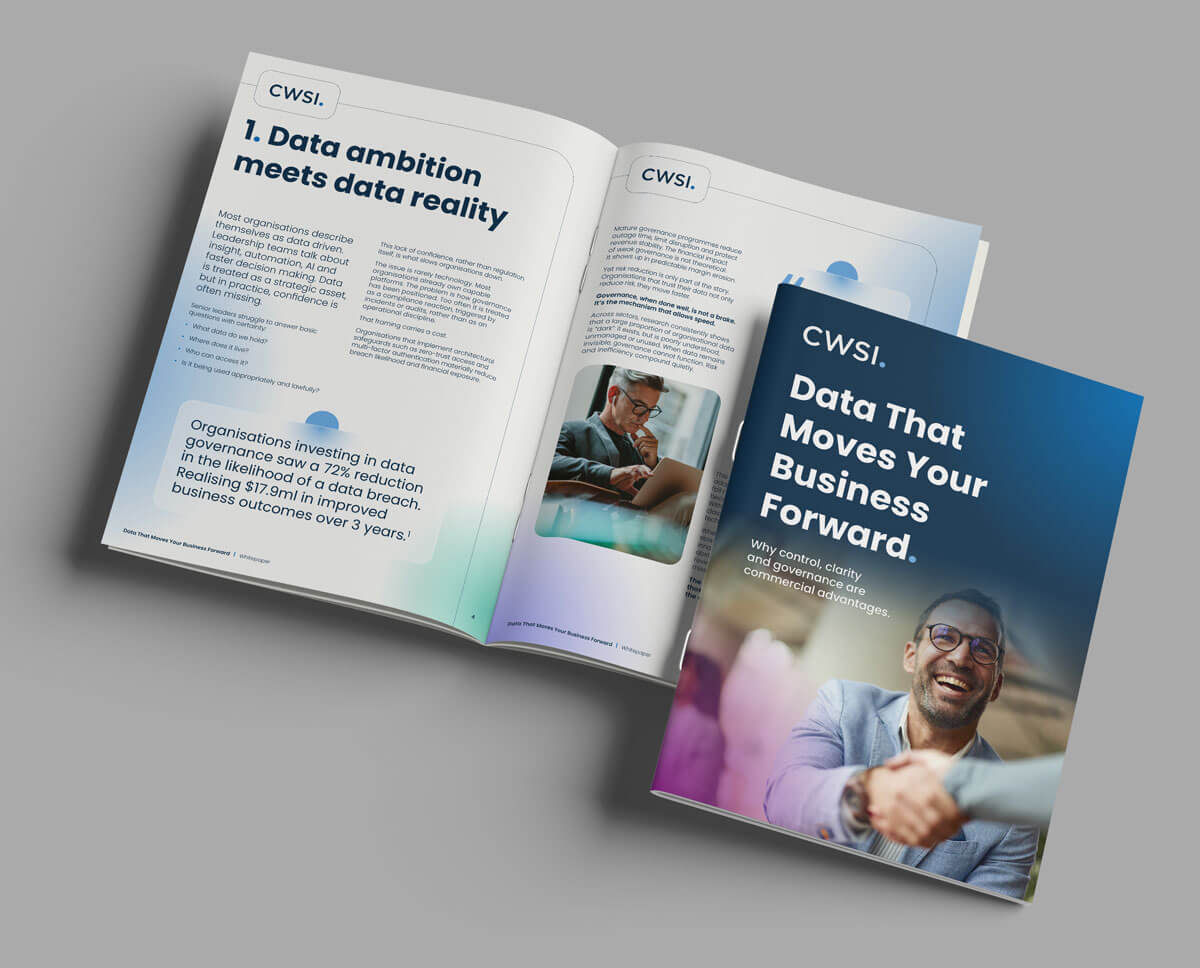
In our latest whitepaper, Data That Moves Your Business Forward, we explore the evidence behind this shift and outline the practical foundations that support it. This includes why data classification often marks a turning point in maturity, how platform-level controls reduce duplicated effort, and what research reveals about the relationship between governance, breach impact and operational performance.
For organisations that want to adopt AI confidently, operate efficiently and satisfy increasing scrutiny without slowing progress, the conversation is no longer about adding more controls. It is about building clarity around the ones that already exist.
If governance still feels like an obstacle rather than infrastructure, it may be uncertainty, not control, that is holding the organisation back.